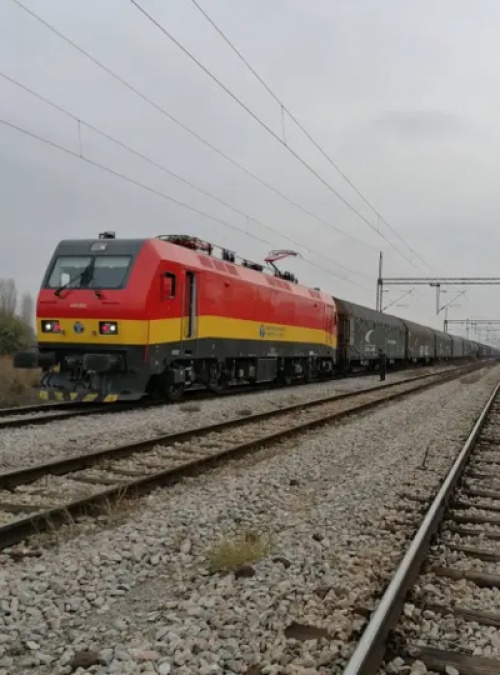
€149 million EU grant advances Rail Corridor VIII in North Macedonia
A €149 million EU investment grant signed through the Western Balkans Investment Framework has moved the eastern section of Rail Corridor VIII in North Macedonia closer to construction. Combined with financing from the European Investment Bank and the European Bank for Reconstruction and Development, the agreement clears the way for a new works tender for the 23 km railway from Kriva Palanka towards the Bulgarian border.
The investment forms part of the EU’s wider effort to connect the Western Balkans with the Trans-European Transport Network. Corridor VIII links the Adriatic and Black Seas through Albania, North Macedonia and Bulgaria. Completing the route would strengthen regional integration, support trade and bring the Western Balkans closer to European transport and economic networks.
The revised financing arrangements are expected to enable publication of the works tender for the Kriva Palanka section. North Macedonia and Bulgaria are advancing preparations for the cross-border tunnel, for which further financing remains subject to agreement with the relevant European partners. EU-funded technical studies are also supporting future western connections towards Albania. Together, these steps are building momentum along the full corridor.
The amendments were required after the initial works tender was cancelled and the earlier IPA grant was decommitted. They adjust the project implementation structure and financing plan, allowing procurement for the Kriva Palanka section to resume.
Transport Minister Aleksandar Nikoloski described the project as a major step towards strengthening North Macedonia’s position at the intersection of Corridors VIII and X.
Ben Nupnau, Deputy Head of the EU Delegation in North Macedonia, said Corridor VIII would connect the Adriatic and Black Seas through Albania, North Macedonia and Bulgaria. He underlined its contribution to regional resilience, trade, business opportunities and competitiveness, as well as its importance for Europe’s wider transport and security infrastructure.
Nupnau pointed out that the signing event marks a step forward to the implementation of a truly strategic joint project uniting and linking the countries that participate in it.
“It will encourage the shift from road to rail, thus contributing to the EU’s green agenda,” said Nupnau. “The signing of these amendments is an important step towards starting actual works. All necessary adjustments to the implementation structure and financing plan have now been agreed.”
The grant and financing agreements were signed in Skopje on 6 July 2026 in the presence of representatives of the Government of North Macedonia, the European Union, the EIB, the EBRD and Macedonian Railways Infrastructure.
Björn Gabriel, Head of the EIB Representation in North Macedonia, described the amendments as a significant milestone because they clear the way for publication of the works tender in the coming weeks. He also highlighted growing momentum on the eastern connection with Bulgaria and EU-funded technical preparation for western links towards Albania.
Fatih Türkmenoğlu, EBRD Head of North Macedonia, said the 23 km railway would complete the country’s eastern section of Corridor VIII, bring North Macedonia closer to its neighbours and Europe, and create lasting benefits for people and businesses by making travel and trade easier.
Rail Corridor VIII is a strategic east-west route within the Trans-European Transport Network. It links ports, airports, roads and railways from southern Italy through Albania, North Macedonia and Bulgaria to the Black Sea.
North Macedonia is developing the 88 km eastern section of Corridor VIII in three phases, from Kumanovo through Beljakovce and Kriva Palanka to Deve Bair on the Bulgarian border. The phased approach is progressively restoring and extending the country’s east-west railway connection.
The 88 km eastern section is being delivered in three phases. The 30.8 km Kumanovo–Beljakovce section was completed in December 2024 and is operational. Construction of the 34 km Beljakovce–Kriva Palanka section is at an advanced stage, while the new financing arrangements support the final 23 km connection from Kriva Palanka towards the Bulgarian border.
Once completed, the railway will strengthen the east-west link between the Adriatic and Black Seas, reduce travel times and support higher volumes of trade. It will also create opportunities for communities and businesses along the route and encourage a shift from road to rail, helping to reduce congestion and transport emissions in line with the EU’s green agenda.
---
About WBIF and Global Gateway
The Western Balkans Investment Framework (WBIF) contributes directly to Global Gateway, the EU's strategy to boost smart, clean and secure connections in digital, energy and transport, while strengthening health, education and research systems worldwide. Global Gateway aims to mobilise up to €300 billion worldwide in investments through a Team Europe approach, bringing together the EU, its Member States and financial institutions to leverage investments for a transformational impact.