Energy efficiency upgrades completed in 32 public buildings across Sarajevo Canton
The second phase of the project Energy Efficiency in Public Buildings of the Sarajevo Canton has been completed, delivering substantial improvements in 32 public buildings, including schools, kindergartens, student dormitories, and healthcare institutions.
Implemented in partnership with the European Bank for Reconstruction and Development (EBRD), the European Union, and the Government of Austria, the €11 million programme combines a €2 million EU grant, an €8 million EBRD loan, and Austrian-funded technical assistance.
Works carried out include façade and roof insulation, window replacement, heating system upgrades, and LED lighting installation, reducing energy consumption and CO₂ emissions by up to 50% and improving conditions for thousands of users.
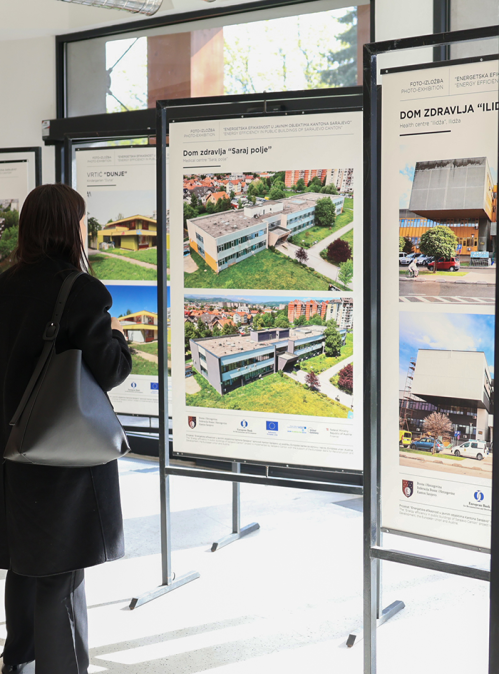
A photo exhibition documenting the building transformations was opened on 25 March 2026 at the European House of Culture and National Minorities. It will be displayed to the public from 26 March to 25 April 2026 in front of the Academy of Fine Arts in Sarajevo, Bosnia and Herzegovina.
Magdalena Mueller-Uri, Head of Cooperation at the EU Delegation to Bosnia and Herzegovina, underlined the EU’s continuous support to increase energy efficiency in BiH, aimed at supporting the green transition, improving conditions in public and private buildings, as well as lowering costs for taxpayers and households. “With a €2 million EU grant, this project is already delivering real results in schools, hospitals and kindergartens in Sarajevo Canton. Energy efficiency improves the quality of life for citizens, saves money, and contributes to a cleaner and greener future.”
EBRD Director for Bosnia and Herzegovina, Stela Melnic, highlighted the importance of the project for sustainable development: “Energy efficiency may seem invisible, but here it is clearly visible, in warmer classrooms, lower energy bills and a healthier urban environment. EBRD looks forward to continuing and scaling up this cooperation in Sarajevo and across Bosnia and Herzegovina, supporting greener and more sustainable cities,” said Melnic.
Prime Minister of Sarajevo Canton Nihad Uk emphasised the project’s tangible impact on public services and budget efficiency: “Citizens expect results from public policies, and this is exactly that: better conditions in classrooms and healthcare facilities, lower costs, and less pollution. We have shown that with clear planning and strong partnerships, we can both save public funds and improve quality of life. We will not stop here. We will continue to expand this model and raise standards across all public buildings in Sarajevo Canton.”
Minister of Education of Sarajevo Canton, Naida Hota-Muminović, pointed to the concrete effects in educational institutions: “The results of energy efficiency projects are already visible through heating bills in schools and kindergartens. Funds that were previously spent on heating are now being redirected towards improving working and learning conditions. These are generational projects with both functional and educational value.”
To date, measures have been implemented in 32 buildings, with preparations underway for an additional four, including facilities of cultural and historical significance. The project delivers environmental and social benefits by reducing harmful emissions – particularly important in Sarajevo where air pollution is high.
The photo exhibition showcases the work of photographers Jasmin Agović, Kenan Tahmiščić, and Dženan Čengić.
---
About REEP
Launched in 2013 under the Western Balkans Investment Framework (WBIF), the Regional Energy Efficiency Programme (REEP) supports renewable energy and energy efficiency investments across the region. With over €1 billion mobilised to date, it has refurbished more than 90 public buildings, supported 1,500 SMEs and 20,000 households. The achieved annual CO₂ emissions saved is equivalent to removing 183,000+ cars from the roads.
---
About WBIF and Global Gateway
The Western Balkans Investment Framework (WBIF) contributes directly to Global Gateway, the EU’s strategy to boost smart, clean and secure connections in digital, energy and transport, while strengthening health, education and research systems worldwide. Global Gateway aims to mobilise up to €300 billion worldwide in investments through a Team Europe approach, bringing together the EU, its Member States and financial institutions to leverage investments for a transformational impact.