At the helm of WBIF: Croatia and Austria on priorities, impact and the road ahead
As Croatia passes the WBIF co-chair baton to Austria, two key voices reflect on the platform's achievements, challenges, and the road ahead for the Western Balkans.
Irena Alajbeg, Croatia
Director-General, Croatian Ministry of Foreign and European Affairs
A Year of Strategic Impact
Q: After a year co-chairing WBIF’s governing boards, what stands out most from Croatia’s experience?
For Croatia, the year as co-chair underscored just how strategic WBIF has become for the Western Balkans. It is not only a financing platform but also a key instrument for driving sustainable development, connectivity, and progress towards EU integration. In a shifting geopolitical context, the experience highlighted the value of a strong, coordinated, and credible EU presence in the region. WBIF helps connect investments, reforms, and the enlargement agenda, turning bilateral support into high-impact investments and tangible results. What stood out most was the platform’s ability to deliver visible improvements in daily life, whether through better water and wastewater systems, stronger energy efficiency, or improved education infrastructure.
At the same time, the year reinforced that WBIF’s strength lies as much in its partnership model as in its financing role. Close coordination between the European Commission, International Financial Institutions (IFIs), and bilateral donors remains essential. The rotating co-chair helps maintain continuity and shared ownership, giving WBIF added political weight and credibility as a stable framework for the EU’s long-term engagement in the Western Balkans.
Q: As Austria takes over, what advice would Croatia pass on?
Looking ahead, Croatia urges Austria to focus on several priorities. Maintain continuity and strategic focus to sustain momentum in delivering high-impact, reform-linked investments. Promote visibility and communication of results to strengthen trust in EU-supported initiatives among citizens and stakeholders. Safeguard the role of bilateral donors, as they remain a key pillar of WBIF through their financial contributions and strategic guidance.
Regular in-person engagement should be encouraged to ensure political ownership, coordination, and mutual trust. Preserve WBIF’s inclusive and partnership-based nature, particularly the meaningful participation of local actors, including National IPA Coordinators (NIPACs), in governance meetings. Above all, WBIF must maintain a strong political commitment to enlargement, serving as a tangible expression of the EU’s dedication to the European future of the Western Balkans.
Elisabeth Gruber, Austria
Director of the Department for International Financial Institutions, Austrian Federal Ministry of Finance
Priorities for 2026–2027
Q: Austria is now co-chairing WBIF with Germany for 2026–2027. What are the Bilateral Donors’ top priorities?
For Austria, the priority is to keep WBIF a trusted platform that helps move the Western Balkans closer to the EU. At a time of renewed enlargement momentum, this means turning ambition into concrete reforms, investments, and visible benefits for citizens, while ensuring WBIF remains a meaningful space for both EU and non-EU donors to support shared goals.
This includes supporting the delivery of the Reform and Growth Facility while preserving its performance-based logic. Austria emphasises closely tracking project implementation and grant absorption and ensuring that simplification works in practice. The goal is to ease procedures for beneficiaries, IFIs, and donors without lowering standards or shifting complexity elsewhere.
Austria also wants to protect the role of regional cooperation frameworks like WBIF under the EU’s next Multiannual Financial Framework for 2028–2034. The aim is to keep WBIF at the centre of efforts to mobilise and coordinate resources, align priorities, leverage finance, and deliver results across the region, while preserving its distinct value as a partnership platform.
In short, the focus is on impact: supporting reform, mobilising resources, cutting unnecessary bureaucracy, and ensuring WBIF continues to deliver for the region.
Where WBIF Can Make the Biggest Difference
Q: Austria has a long history of bilateral cooperation with the Western Balkans. Where should support be directed in the coming years, and where can WBIF make the biggest difference?
Austria sees the region’s European perspective and sustainable development as closely linked. In the years ahead, support should remain focused on areas that improve daily life for citizens while also helping the Western Balkans converge with the EU.
Within WBIF, this means continued investment in social and environmental sectors, where needs remain high and impact is immediate. Wastewater and waste management, climate resilience, renewable energy, education, and social infrastructure all stand out as priorities. These are the sectors that shape quality of life, environmental protection, and social cohesion, yet they often depend on WBIF backing because they are not the most commercially attractive.
Austria and the Bilateral Donors also bring more than funding: technical expertise, reform experience, institutional partnerships, and business links. Through WBIF, these strengths can be combined with EU and IFI resources to turn strategic priorities into projects that deliver real results on the ground.
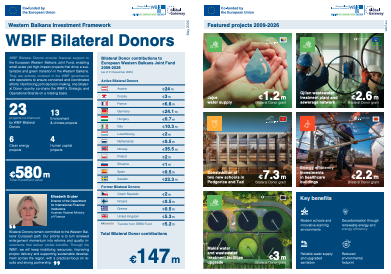
Want to know more about Bilateral Donor co-financed projects in WBIF? Check out the latest factsheet