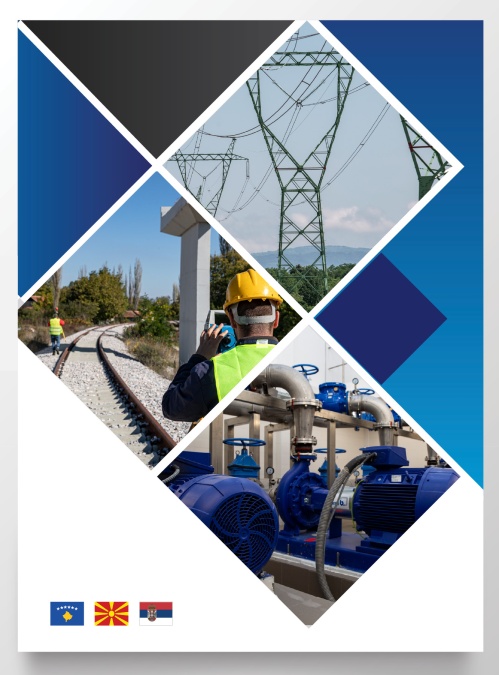
European Commission reviews progress of key EU-supported investments in the Western Balkans
From 22 to 26 June 2026, a team from the European Commission's Directorate-General for Enlargement and the Eastern Neighbourhood (DG ENEST) returned to the Western Balkans for the second monitoring mission to review implementation of key investments financed by the Western Balkans Investment Framework.
The mission covered Serbia, North Macedonia and Kosovo* (the previous mission covered the three other Western Balkans partners), combining high-level discussions on the status of the WBIF portfolio with sector-specific technical meetings on transport, energy, digital, and the environment. Site visits to a selection of projects gave a first-hand view of how European funding is improving quality of life across the Western Balkans.
Serbia
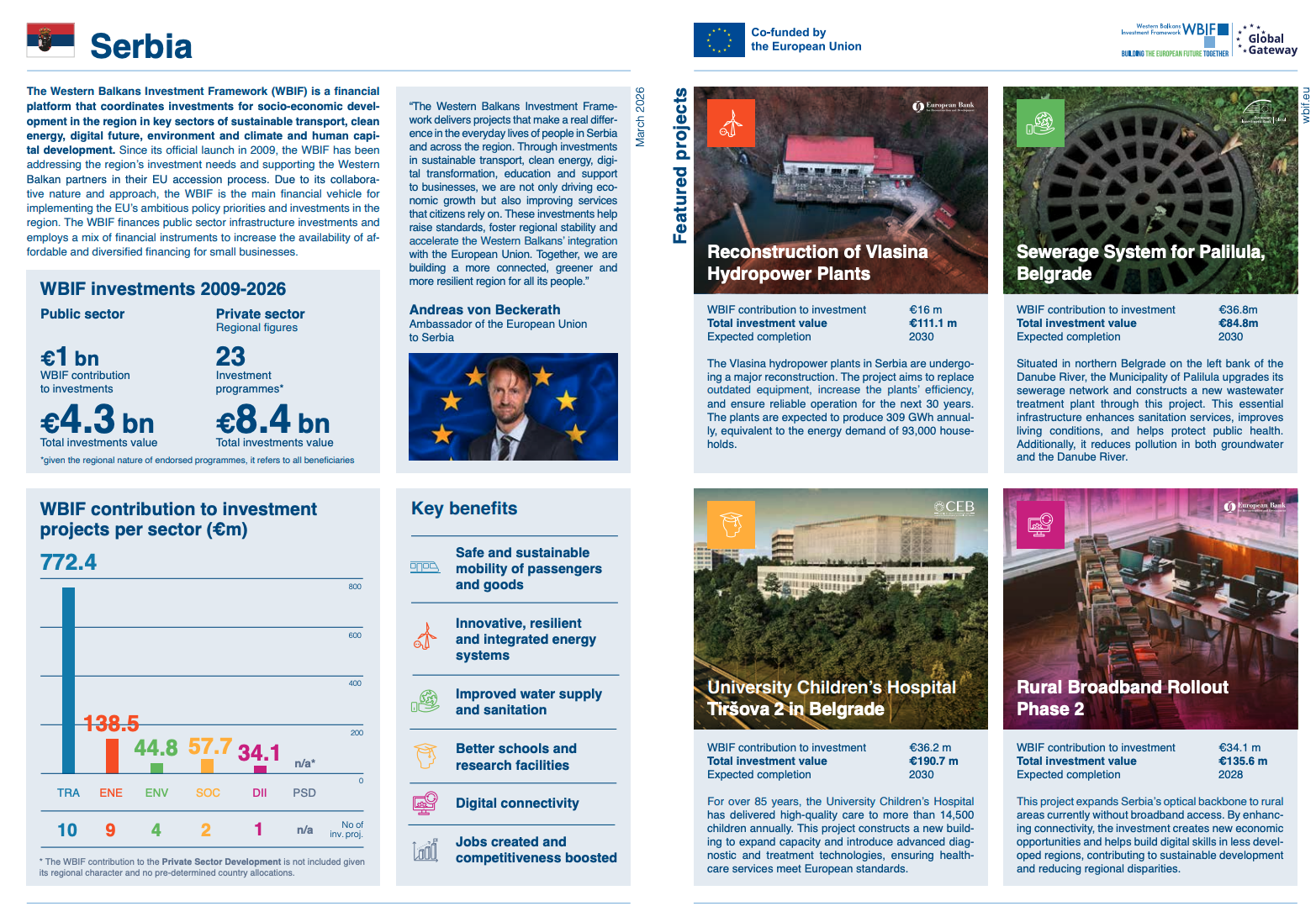
Since 2009, the EU, through the WBIF, has contributed €1 billion to 26 infrastructure investment projects in Serbia.
During a high-level meeting on 22 June 2026, DG ENEST met with representatives of the Ministry of Finance and the Ministry of European Integration (the NIPAC Office of Serbia). Together with WBIF partner financial institutions - the European Investment Bank (EIB), the European Bank for Reconstruction and Development (EBRD), Council of Europe Development Bank (CEB), French Development Agency (AfD) and KfW Development Bank – DG ENEST reviewed the state of implementation of the EU-supported projects and discussed how progress could be accelerated by removing key obstacles.
Strategic projects in rail, energy and water and waste management
A dedicated meeting on Transport projects examined the progress on different sections of the Corridor Xc railway line through Niš, including the so-called 'Peace Highway' Niš-Merdare. Transport projects account for the majority of the funds invested in Serbia across 10 investments. A visit to the Niš bypass allowed the delegation to witness how this single-track electrified line will improve transit times for freight and passengers through Serbia's third-largest city.
Projects on the Environment sector, such as the sewerage systems (Palilula, Belgrade), landfill replacements in Novi Sad and closures in Pirot, Sremska Mitrovica and Valjevo regions were examined. The projects aim to improve environmental protection and public health by reducing pollution, enhancing wastewater and waste management services, and supporting the transition to sustainable and EU-compliant environmental infrastructure.
Technical meetings on Energy focused on tender progress for the rehabilitation of Bistrica and Potpec hydropower plants; and a review of the Trans-Balkan electricity corridor that will connect the electricity transmission systems of Serbia, Montenegro and Bosnia and Herzegovina to those of Croatia, Hungary, Romania and Italy.
Persistent obstacles slow implementation
The main areas where progress is still needed include improved prioritisation of infrastructure investments for EU support through strengthened stakeholder consultations, more efficient project preparation and grant application procedures, reduced implementation delays, and enhanced monitoring and reporting across the project cycle.
More information regarding projects in Serbia can be found in the factsheet below
North Macedonia
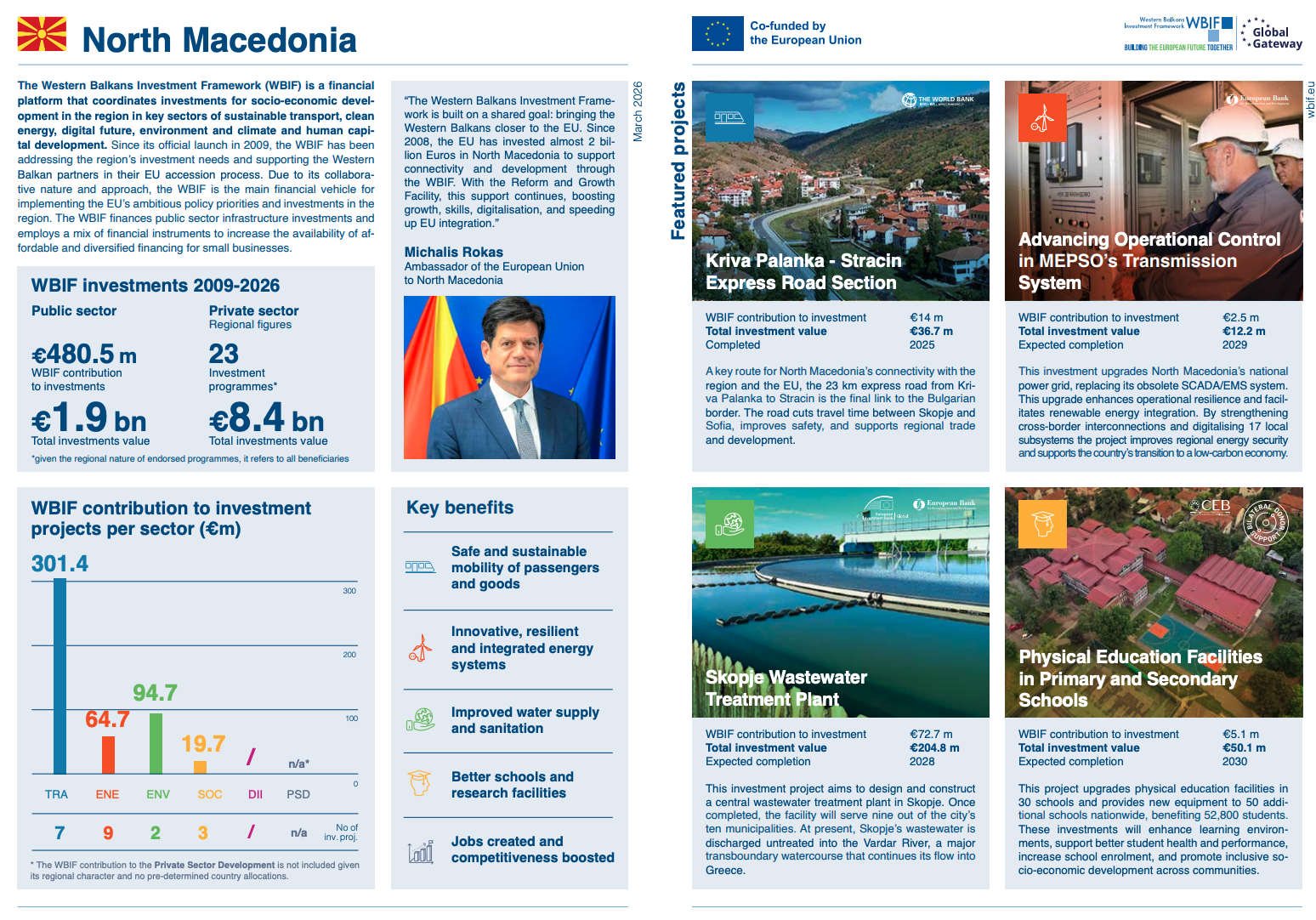
On 24 June 2026, the delegation met in Skopje with officials from several ministries, including Ministries of European Affairs, Finance, Transport, Energy, and Environment, as well as representatives of the WBIF partner financial institutions EIB, EBRD, KfW and Agence Francaise de Developpement (AFD). The meeting reviewed the state of implementation of the €480 million portfolio across 21 public sector projects.
Strategic projects in rail, energy and environment
Dedicated meetings on transport, environment and energy projects focused on strategic investments such as the progress on rail corridors VIII and X, part of the Western Balkans–Eastern Mediterranean European transport corridor.
Energy projects reviewed included the Albania-North Macedonia Power Interconnection, solar photovoltaic power plants Bitola and Oslomej 2, and the tendering for rehabilitating six hydropower plants in Mavrovo, Crn Drim and Tikves.
A technical meeting on the regional waste management system was complemented by a visit to Skopje's wastewater treatment plant, together aiming to develop EU-compliant waste services for over 1.6 million residents.
From implementation to impact
The mission concluded that attention and efforts should focus on improved implementation and impact of the supported projects. Systemic project preparation processes should ensure robust integration of land, legal and feasibility constraints, while formal governance structures should be in place to prevent potential blockages in implementation.
More information regarding projects in North Macedonia can be found in the factsheet below
Kosovo
The final stop of the mission was Kosovo on 26 June 2026, where a high-level meeting on the WBIF portfolio brought together representatives of the Ministry of Finance, Labour and Transfers, Transport and Infrastructure, Economy, Environment and Spatial Planning, and Digitisation and Public Administration, and WBIF partner financial institutions EBRD, KfW and AFD.
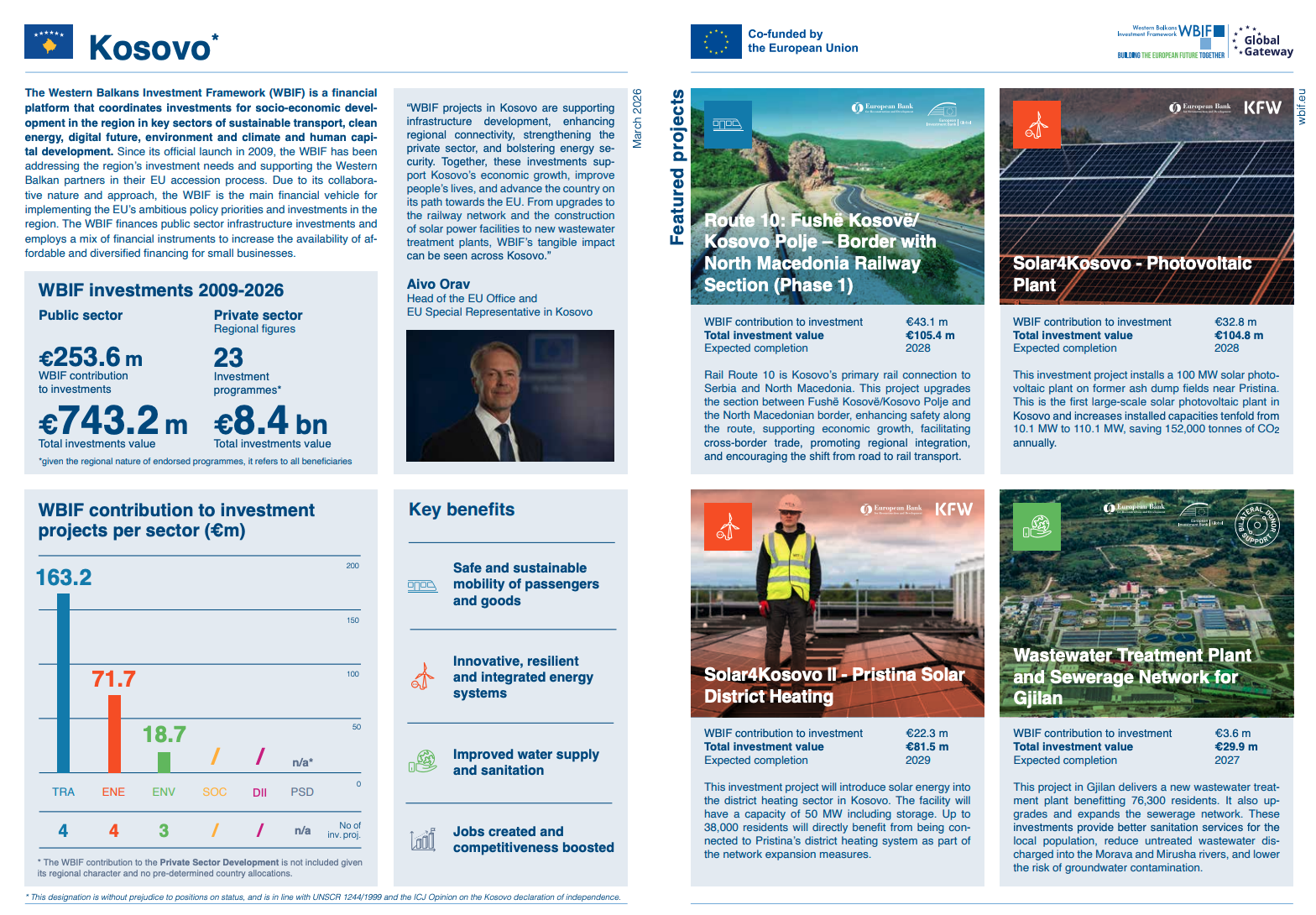
Since 2009, more than €250 million has been invested in infrastructure projects in Kosovo across the transport, energy, and environment sectors. Discussions pointed to the need to accelerate the implementation of the WBIF projects portfolio in Kosovo after a period of inaction.
Several investments under review
A first meeting focused on Transport projects Rail Route 10 – Kosovo's primary rail connection to Serbia and North Macedonia – and the Peace Highway on the Kosovo side. Two dedicated meetings on Energy explored the Solar4Kosovo projects – one on the photovoltaic plan, the other on the solar district heating project. Across the board, it is important to accelerate procurement procedures. The Environment sector meeting examined developments in the wastewater treatment plants in Gjilan and Mitrovica, concluding that a solution for the location of the Wastewater Plant in Mitrovica should be resolved.
Finally, a dedicated meeting on Digital connectivity explored the feasibility of upgrading data centres while the implementation of the broadband infrastructure upgrades has started. Overall, a more proactive role for the Kosovo government is expected through the preparation of roadmap for acceleration of implementation and high-level participation in the Steering Committees which should be established for all investment projects.
More information regarding projects in Kosovo can be found in the factsheet below
Stronger governance and steering are key
Across the three partners, the mission confirmed that EU-supported investments are moving forward, but that faster implementation will depend on stronger ownership and coordination, better project preparation and more proactive governance.
---
About WBIF and Global Gateway
The Western Balkans Investment Framework (WBIF) contributes directly to Global Gateway, the EU's strategy to boost smart, clean and secure connections in digital, energy and transport, while strengthening health, education and research systems worldwide. Global Gateway aims to mobilise up to €300 billion worldwide in investments through a Team Europe approach, bringing together the EU, its Member States and financial institutions to leverage investments for a transformational impact.
* This designation is without prejudice to positions on status, and is in line with UNSCR 1244/1999 and the ICJ Opinion on the Kosovo declaration of independence.