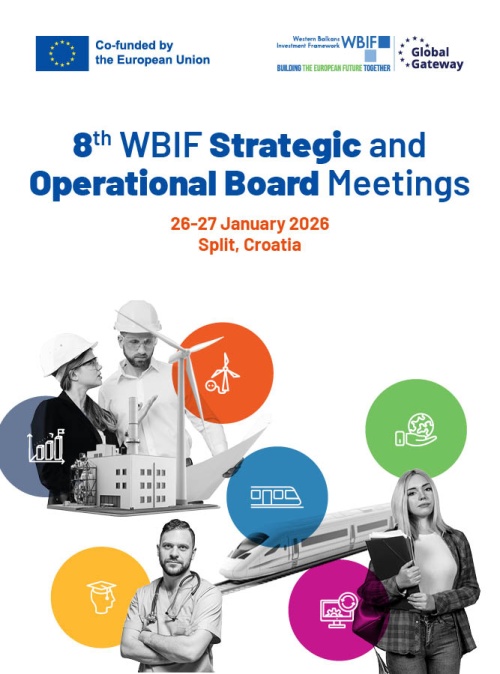
WBIF board endorses €171 million package for infrastructure and business support
The European Commission has announced €171 million of support to boost infrastructure development and private sector growth across Western Balkans partners.
The new support package includes an investment contribution package from different EU funding sources: contributions from the Instrument for Pre-accession Assistance (IPA III) for a project in Bosnia and Herzegovina, contributions from WBIF bilateral donors for a project in Montenegro, and contributions from the Reform and Growth Facility (RGF) for projects in Albania, Montenegro and North Macedonia.
The funding package, endorsed by WBIF Operational Board on 27 January 2026, includes investment and technical assistance projects approved today, reinforcing the EU's commitment to sustainable growth and regional connectivity in the Western Balkans.
Significant investments for infrastructure
Of the total package, €91.8 million is allocated to infrastructure projects in the four partners.
This funding is expected to mobilise €263 million in total investments across seven projects in priority sectors, including digital, clean energy, human capital, transport and environment. Key projects include:
- rollout of broadband infrastructure in Albania;
- improvement of the electricity transmission system in North Macedonia;
- construction and energy-efficient renovation of education facilities in North Macedonia and Montenegro;
- electrification of the Durres-Tirana Railway line in Albania; and
- drinking water and wastewater treatment project in Bosnia and Herzegovina.
These projects will be implemented by the Western Balkan partners together with international financial institutions.
In addition, €2.9 million is allocated to four technical assistance projects in Albania and Bosnia and Herzegovina, aimed at supporting future investments in energy, water, innovation, and research sectors.
Supporting private sector development
The package also includes €76.3 million in contributions to programmes supporting the private sector, including:
- the Western Balkans Forward Programme, helping small and medium-sized companies (SMEs) export more advanced products and services to the region and the EU;
- SME Go Green Programme, promoting green, circular economy, agribusiness and investments in jobs and growth;
- the Western Balkans Opportunities by Non-traditional Debt (W-BOND) pilot programme, providing SMEs with access to finance by diversifying funding sources beyond traditional bank loans;
- strengthening public-private partnership capacities and governance in Bosnia and Herzegovina.
The projects can now proceed with finalising the necessary agreements with partner institutions and beneficiaries, launching preparatory studies for technical assistance activities, and completing the procedures required to enable implementation of private-sector projects. Once these processes are completed, implementation of the supported investments can begin.
See Factsheet – Summary of WBIF Investments
The Western Balkans Investment Framework (WBIF) is a joint initiative of the EU, financial institutions, bilateral donor and beneficiaries, aimed at enhancing harmonisation and cooperation in investments for the socio-economic development of the region and contributing to the European perspective of the Western Balkans.
WBIF is instrumental in implementing the Reform and Growth Facility, channelling €3 billion in grants and loans under the Facility to support priority investments in transport, energy, digital and human capital.
Herzegovina bridge on Počitelj-Zvirovići section, Road Corridor Vc in Bosnia and Herzegovina
About WBIF and Global Gateway
The Western Balkans Investment Framework (WBIF) contributes directly to Global Gateway, the EU’s strategy to boost smart, clean and secure connections in digital, energy and transport, while strengthening health, education and research systems worldwide. Global Gateway aims to mobilise up to €300 billion worldwide in investments through a Team Europe approach, bringing together the EU, its Member States and financial institutions to leverage investments for a transformational impact.